![AI Tinkerers Chicago: June Meetup ft Coinflow and UChicago Graham School [AI Tinkerers - Chicago]](https://images.aitinkerers.org/cdn-cgi/image/width=300,fit=scale-down,format=auto,quality=75/ai_tinkerers/logos/ai_tinkerers_-_chicago_laptop-sticker_190_521b1fc408a63ca839e3eddd61cf932f.png)






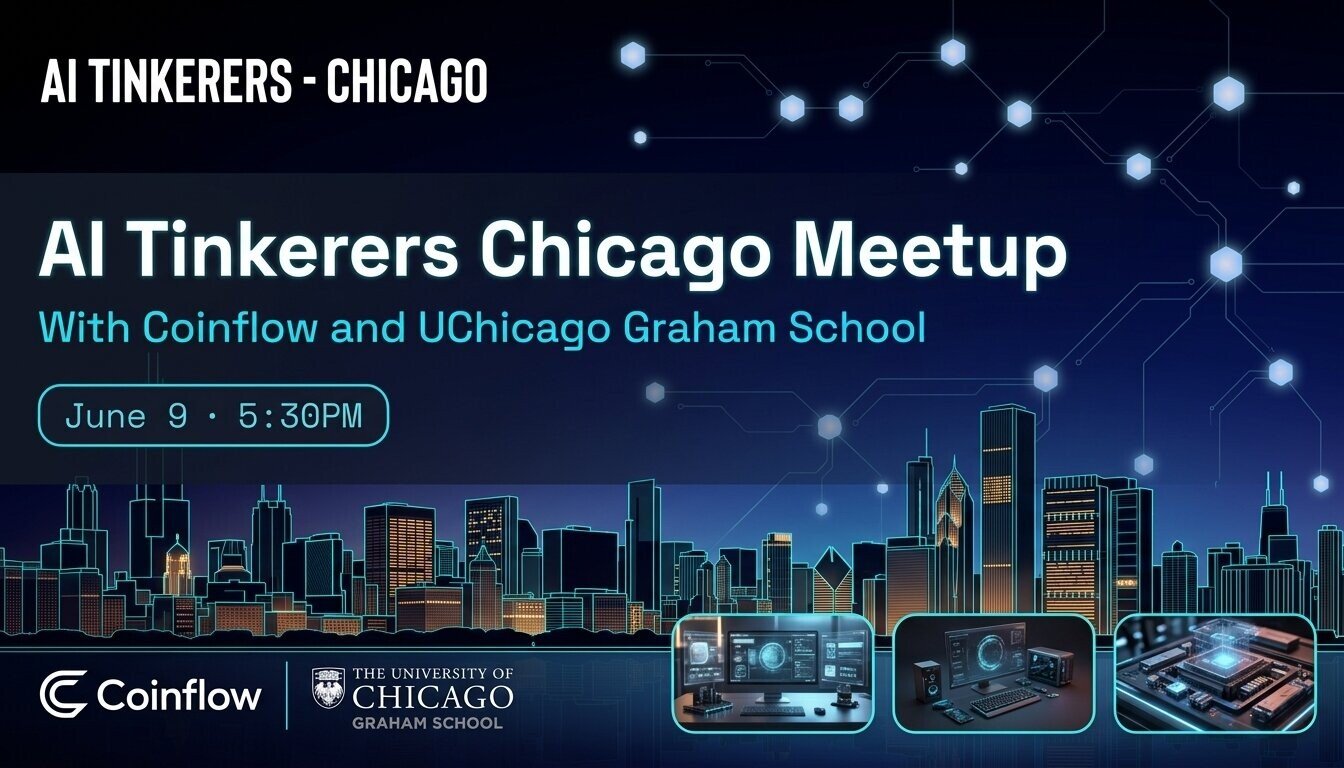
AI Tinkerers Chicago: June Meetup ft Coinflow and UChicago Graham School
🛠️ Hands-On Technical Show-and-Tell
On Tuesday, June 9th, 2026, we are gathering Chicago’s active AI engineers, researchers, and technical founders for our June meetup. This is a pure builder-first environment focused on raw code, technical trade-offs, and live deployments. We enforce a strict ban on slide decks; every presenter must showcase working software, messy experiments, or architectural walkthroughs.
Whether you are optimizing context windows, orchestrating agentic workflows, or resolving production latency bottlenecks, this is the room to trade hard-won lessons with peers who are actively shipping generative AI systems.
🏆 Special Guest: Benjamin Meeder, CTO & Co-Founder, Coinflow
Ben is the CTO and Co-Founder of Coinflow, where he leads the engineering team connecting traditional payment rails with stablecoin technology to enable instant global settlement for trusted, cross-border commerce. He combines deep technical expertise with a business-first mindset to ensure the platform delivers on Coinflow’s vision of trusted, instant, and programmable global payments.

Before Coinflow, Ben was part of the core platform engineering team at ServiceNow, focused on developer tooling for enterprise customers, and later co-founded a sports gaming startup that achieved a successful exit. He holds a degree in Software Engineering and an MBA in Technology and Innovation Management. With a proven track record in scaling resilient, enterprise-grade systems and growing strong technical teams, Ben thrives at the intersection of technology, product, and business growth.
🎙️ Show Your Work: Call for Demos
We are actively seeking builders to present technical deep-dives and live demos. We prioritize raw code over slides and engineering discoveries over product pitches. Your demo should focus on how you solved a specific technical challenge and what other builders can reuse or avoid.
Submit Your Demo Proposal Here
🥽 Speakers
Self-Running Analytics: Conversational Dashboards

Rohit Pujari
CEO @ Semaphor
🗓️ Schedule and Logistics
- Date: Tuesday, June 9, 2026
- Time: 5:30 PM - 7:30 PM
- Location: Peoria St, Chicago, IL (Exact address and access details provided to approved attendees)
- Capacity: 150 practitioners
🛡️ Curation Policy
AI Tinkerers is selective by design to maintain a high-signal environment. Attendance is strictly limited to active developers, researchers, and technical founders. We manually screen every registration to ensure the room is filled with practitioners who can pop the hood and discuss implementation details. Space is highly limited and our Chicago events consistently run with a waitlist.
🤝 Our Partners
UChicago Graham School provides rigorous, Socratic-style education for lifelong learners and professionals, bridging historical, ethical, and scientific inquiries with contemporary technological challenges.
Coinflow provides payment infrastructure and settlement solutions, enabling seamless financial orchestration for modern technical platforms.
Interested in supporting the local builder ecosystem? See sponsorship opportunities.
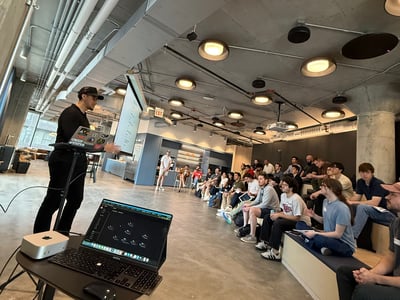
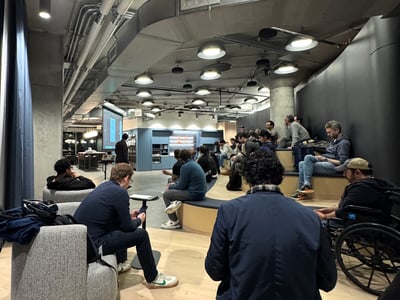
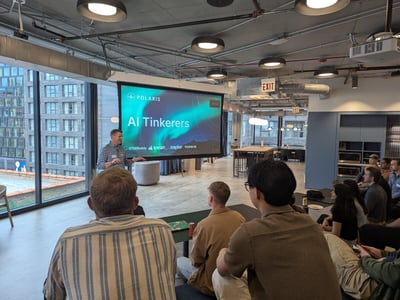
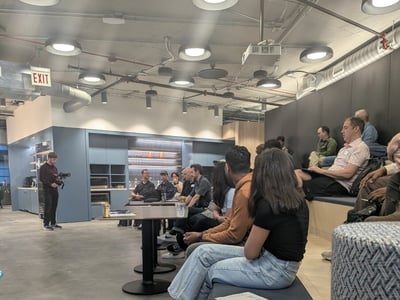
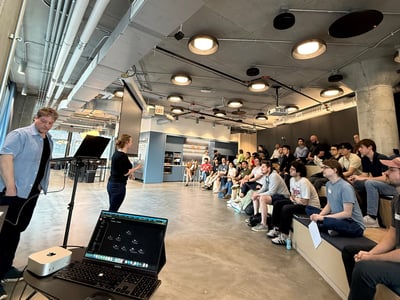
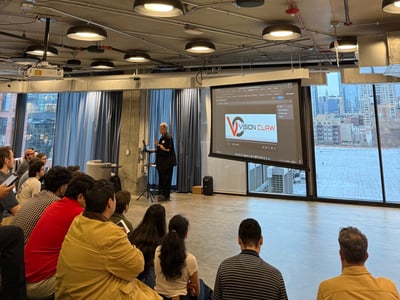
Event photos
📊 AI Tinkerers Chicago Stats
- Attendees: This exclusive community of 2,198 AI professionals features a highly technical membership, with 80% specializing in Python-driven machine learning, 65% in generative AI and LLM orchestration, and 40% in cloud infrastructure. Notably, over 30% of members are active startup founders or CTOs, bridging academic excellence from UChicago and Northwestern with enterprise execution at firms like Google and Stripe.
- Companies Represented: Featuring tech giants like Google, Microsoft, NVIDIA, and Apple, alongside prominent platforms like DoorDash, TikTok, Waymo, and Robinhood, and innovative startups such as ElevenLabs, Pinecone, Hume AI, and HumanLayer, and more
- Demos: 184 demos have been submitted and 107 have been presented, with especially engaging coverage of agentic and multi-agent architectures, reliable structured generation/tool calling, and multiple flavors of retrieval-augmented generation (including graph and dynamic filtering approaches). Attendees also explored workflow automation pipelines, evaluation/observability for agents, and performance/cost optimization for real-world deployments, plus multimodal generation and structured data extraction.
- Testimonials:
A great demo shows working software or verifiable system behavior, not just a promising concept. Follow a builder-first style: clearly describe the specific technical challenge you solved, then demonstrate the mechanism in action (e.g., how the system behaves on different real cases, how it handles missing information, how components “contract” with each other). Audience members respond strongly to demos that produce inspectable artifacts—logs/graphs, structured intermediate state, or editor-ready project models—because it lets others understand what to copy and where trade-offs live. They also like demos that translate complexity into an approachable but still technical framing (as in a strong analogy) while maintaining architectural substance. Avoid slide-deck/marketing-pitch vibes: if you can’t show code/workflow details, failure-mode handling, or a tangible output artifact, ratings tend to suffer. Also ensure delivery quality (audibility/clarity), since even an interesting technical demo can underperform if the audience can’t follow it.
In Chicago, Luis Cisneros’ Teaching a Clinical Multi-Agent System to Say I Don’t Know earned a perfect 5/5 from two raters because it demonstrates a clinically grounded multi-agent system that abstains rather than guessing: the demo walks through multiple real cases, showing how agents converge, how disagreement is surfaced to the clinician, and how out-of-distribution cases are formally routed to human review—plus promised access to orchestration graphs, conflict logs, and the CCR tolerance-band math. Also in Chicago, Katarina Coates’ Training AI Like a Dog: What Behavioral Science Reveals About Model Alignment landed well (4/5) with audience feedback calling out the “dog-training analogy” as relatable, while still describing a real architectural idea: a behavioral auditing/intervention layer built alongside a local small model that targets root causes of drift rather than surface suppression. Finally, Pat Narendra’s Building an Agent-Human Interactive Video Studio received 4/5 (single rater) because it emphasizes a durable, inspectable human-in-the-loop workflow: agents produce scene-first structured files (script/visual intent/assets/narration settings/approval state), humans approve per-scene changes, and a deterministic renderer only consumes approved data—positioning video as “code” with resumable, debuggable, repairable outputs.