![AI Tinkerers Chicago: April Meetup ft OneTwoLoop [AI Tinkerers - Chicago]](https://sloppy-joe-app.imgix.net/ai_tinkerers/logos/ai_tinkerers_-_chicago_laptop-sticker_190_521b1fc408a63ca839e3eddd61cf932f.png?w=300&fit=max&auto=format%2Ccompress&q=75)








AI Tinkerers Chicago: April Meetup ft OneTwoLoop


🔥 April 14, 2026: 5:30 PM – 7:30 PM 🔥
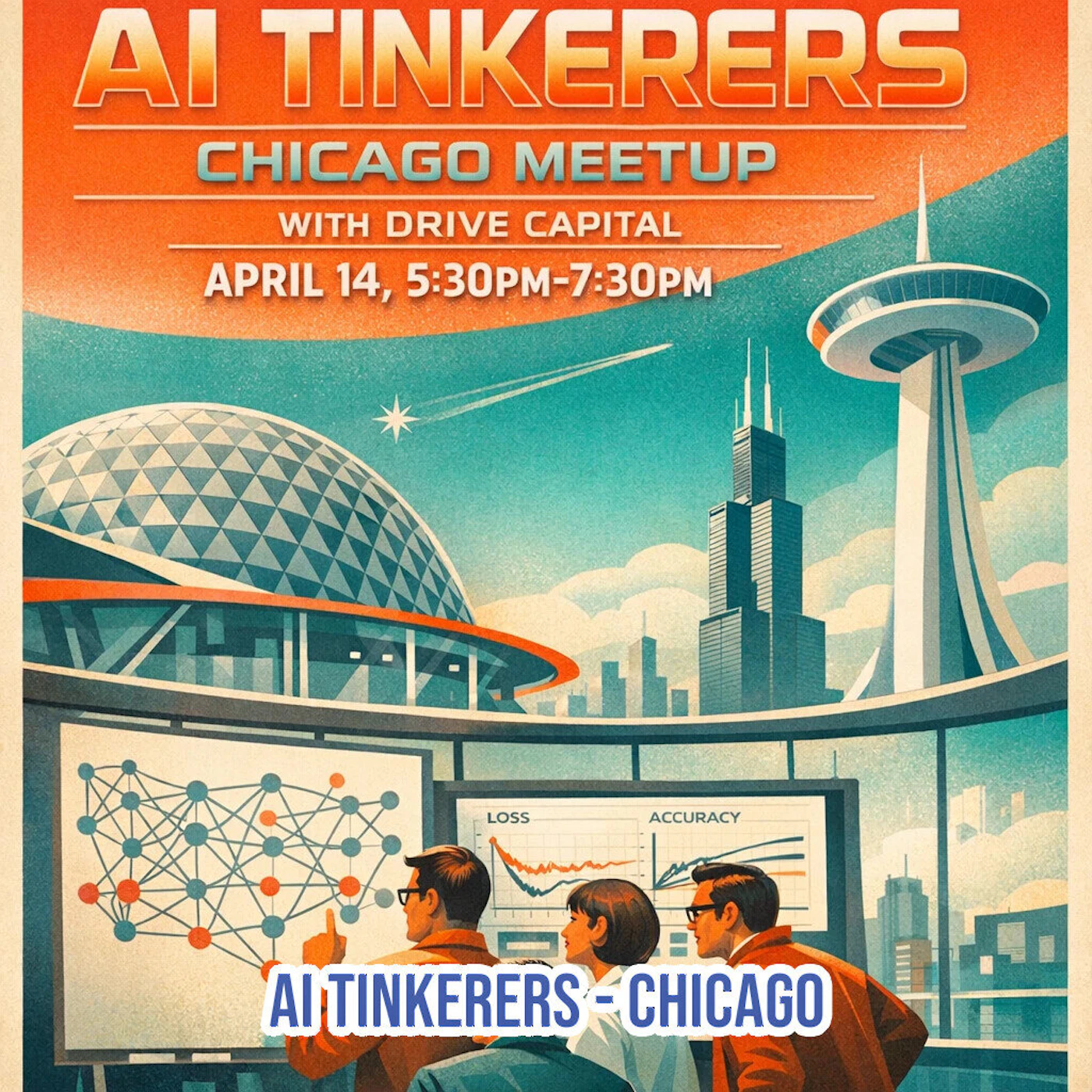
Join the Chicago chapter of AI Tinkerers for our April gathering. This is a curated, technical environment for engineers, researchers, and founders to share working systems, dissect architecture, and trade hard-won lessons from the frontier of generative AI.
AI Tinkerers is a high-trust space for honest technical work. We prioritize signal over noise, focusing on the “how” and “what” of your build rather than product pitches. If you are actively shipping LLM-powered features, building novel agentic workflows, or experimenting with the latest frontier models like Claude Opus 1M or GPT-5.4, this is the room where you accelerate your roadmap.
Huge thanks to our partners for supporting the Chicago builder community:
Drive Capital is a Columbus-based venture capital firm managing $2.2B in assets. They focus on partnering with founders across America to build market-defining companies from seed stage through IPO.

onetwoloop - OneTwoLoop is a project that AI Tinkerers Chicago co-host Landon Campbell is working on to connect Chicago’s top engineers with the city’s most exciting companies. Check it out and share feedback with Landon at [email protected]

Live Demos: Architecture, Trade-offs, and What Broke
We are accepting proposals for short, technical show-and-tell demos. Skip the slides; focus on the implementation details. Your five-minute demo should answer one core question: “How did you build this?”
We want to see your messy experiments, creative hacks, and technical breakthroughs. Whether it is a novel context engineering setup using the new 1M token windows, complex agentic orchestration with OpenClaw, or near-instant generation using specialized Llama 3 silicon, the stage is for those actively building.
Submit Your Demo Proposal: https://chicago.aitinkerers.org/meetup/mu_ogFsByFYY90/speaking
🥽 Speakers
What Happens When You Put an AI Dev Team on a Mac Mini?

Justin Bergeron
CTO @ HausHavn
Connecting Chicago engineers with the right companies

Landon Campbell
GM @ Drive Capital
Training AI Like a Dog: What Behavioral Science Reveal…

Katarina Coates
Master Level Dog Trainer paired with a Senior Software Engineer @ Steel City K9 Emergency Response Team
How Personalized AI Outputs Turned Our Internal Tool I…

Chris Pieta
Founder & COO @ Chris Pieta LLC
VisionClaw Agent an Agentic AI Corporation Platform

Robert T Washburn
Founder @ AI-BUDDY LLC
Schedule and Logistics
- Date: Tuesday, April 14, 2026
- Time: 5:30 PM – 7:30 PM
- Location: Chicago, IL (Specific venue details provided to accepted attendees only.)
- Capacity: 150 attendees
Curation Policy
AI Tinkerers is selective by design. Attendance is strictly screened to ensure the room is filled with practitioners who can pop the hood and share their stack. Space is highly limited and events consistently run with a waitlist.
Interested in supporting the local builder ecosystem? See sponsorship opportunities.
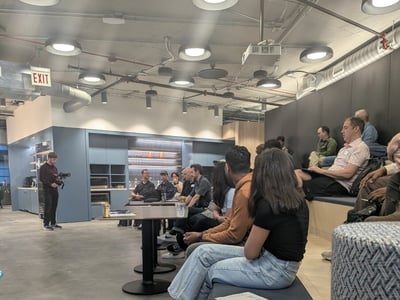
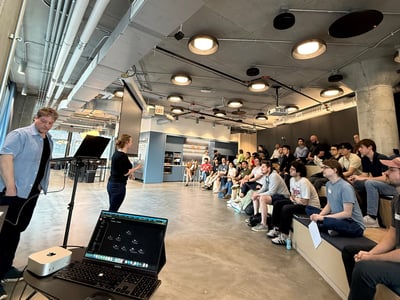
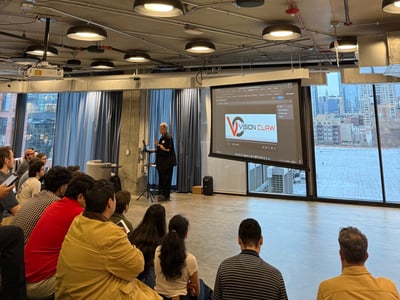
Event photos
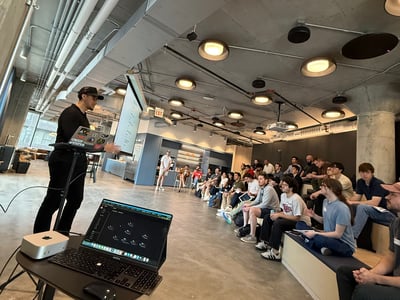
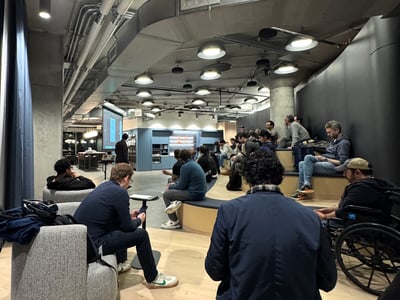
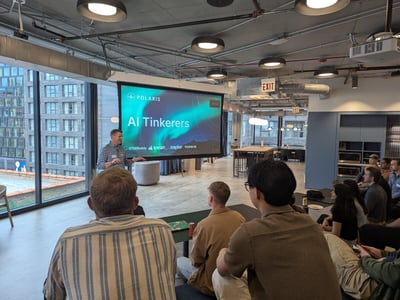
📊 AI Tinkerers Chicago Stats
- Attendees: This exclusive community of 2,189 subscribers comprises 52% AI/ML specialists and 68% full-stack engineers, with 32% holding founder or executive titles. Members represent elite institutions like UChicago, UIUC, and Google. Notable achievements include deploying production-grade agentic workflows, building open-source developer platforms, and engineering FDA-cleared medical AI, making this Chicago’s premier hub for high-signal technical collaboration.
- Companies Represented: Featuring tech giants and AI leaders like Google, Microsoft, NVIDIA, and Waymo, alongside fast-growing platforms such as DoorDash, Robinhood, TikTok, and Pinecone, and emerging startups like ElevenLabs, HumanLayer, Autonoma AI, and pieces.app, and more
- Demos: 184 demos have been submitted and 107 have been presented. The most exciting themes have centered on agentic workflows, retrieval and knowledge-centric systems, and production-grade reliability via evals, observability, and guardrails. Technical exploration has also highlighted structured generation (function calling and schemas), efficiency/cost optimization for LLM pipelines, and practical multimodal/document processing.
- Testimonials:
A great demo in this format is one where the presenter demonstrates a real technical system (not slides or a marketing narrative) and makes the core lesson observable through artifacts, logs, or editable intermediate state. High-performing talks turn “big ideas” into concrete architecture decisions: they show how design choices prevent common failure modes (e.g., structural abstention vs thresholding, grounding and explicit evidence gaps instead of prompting alone), and they expose the boundary between agent proposals, human review, and deterministic downstream consumption. They also minimize black-box vibes by showing the “contracts” the system uses (manifests, schemas, tolerance bands, retrieval context, verification tags) so others can replicate the pattern. Demos should avoid under-specification and pitchiness: when technical content is missing, the workflow can’t be inspected, the talk feels like a high-level product description, or the demo is impaired by execution issues (like being inaudible), audience ratings drop.
The highest-rated demos show what works in practice. In Chicago, Luis Cisneros’ Teaching a Clinical Multi-Agent System to Say I Don’t Know stands out because it directly tackles “I don’t know” as an architectural behavior: the system abstains outside a calibrated zone rather than collapsing different failure modes into a single confidence threshold. The demo promises live walkthroughs, conflict-detection logs, and a structured chart artifact, which signals to builders that they’ll see real system mechanisms—not just a conceptual story. Also in Chicago, Pat Narendra’s Building an Agent-Human Interactive Video Studio is praised because it frames video production as an inspectable, resumable workflow: a scene-first manifest becomes a clean authoring contract for the agent, a review surface for the human, and deterministic input for the renderer. The ratings reflect that this kind of contract-driven orchestration and edit/approval loop is the sort of reusable engineering pattern that other builders can learn from and adapt.